
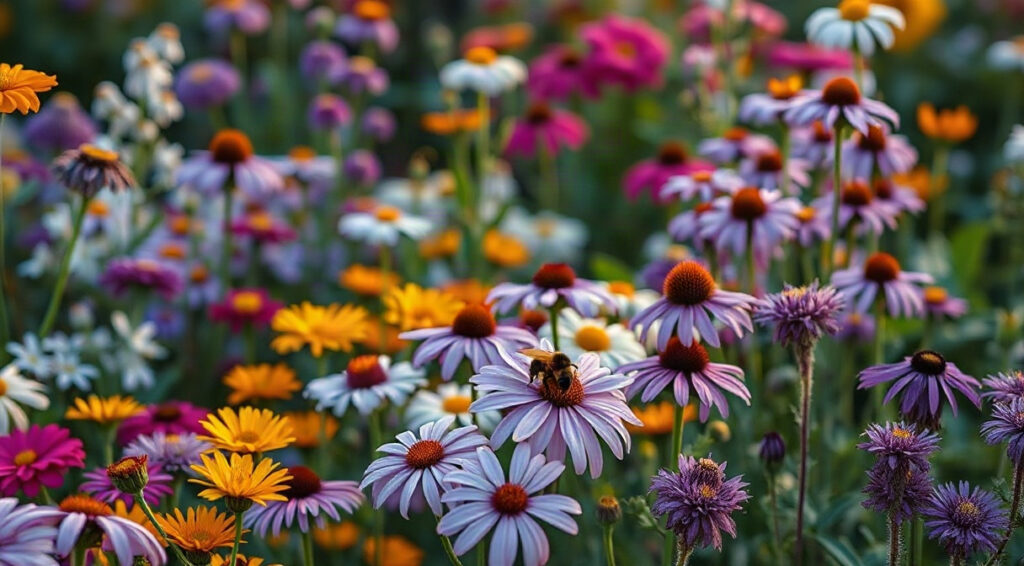
Bee friendly garden plants can turn a few sunny beds into a steady source of nectar and pollen, provided something useful is flowering from early spring through late autumn. The key is not planting one spectacular patch that blooms for a fortnight; it is combining regionally appropriate flowers with different bloom times, shapes, and heights. This guide shows how to choose native species, arrange them in accessible drifts, and maintain flowers without disrupting the bees that visit. Plant recommendations below lean toward eastern and central North America, so check local native-plant lists before buying; a plant native in one region may be unsuitable in another.
Plan a Season of Bee Friendly Garden Plants
Start by mapping the bloom calendar, not by choosing colors. Bees need food when they emerge in spring, while colonies are growing in summer, and as late-flying workers forage in autumn. A border that looks full in June but offers little in April or September leaves important gaps. Walk your garden every two or three weeks from early spring to frost and note what is flowering. Nearby trees and shrubs count, too: a mature willow or redbud may provide more early forage than a dozen small perennials.
For a broad temperate North American calendar, aim for three or more useful flowering choices in each season. In early spring, consider locally native willows such as pussy willow (Salix discolor), spring beauty (Claytonia virginica), and redbud (Cercis canadensis). In late spring and early summer, add wild geranium (Geranium maculatum), golden alexanders (Zizia aurea), and native penstemons such as Penstemon digitalis. Summer can include wild bergamot (Monarda fistulosa), purple coneflower (Echinacea purpurea), and mountain mint (Pycnanthemum species). For late-season forage, leave room for native asters, such as New England aster (Symphyotrichum novae-angliae), and goldenrods, including rough-stemmed goldenrod (Solidago rugosa).
These are examples, not a universal shopping list. In the Pacific Northwest, Southwest, or outside North America, select flowers native to your own ecoregion and suited to local rainfall. A county extension service, native-plant society, or regional botanical garden can help identify trustworthy species. Check the scientific name on the label: common names are often shared by unrelated plants. Also ask whether a named cultivar has been selected for unusual flower form or low pollen production. Double flowers can hide nectar and pollen or make them difficult for bees to reach.
- Early spring: choose flowering shrubs, trees, and small woodland flowers for cool days when few other plants are open.
- Late spring to midsummer: combine open, accessible flowers with several shapes and staggered bloom periods.
- Late summer to autumn: reserve space for asters, goldenrods, and other locally native flowers that keep producing until frost.
Think of this as a relay: one plant group begins flowering before another finishes. Check expected bloom time for your area, because a plant’s calendar shifts with latitude, elevation, weather, and exposure. Leave a few weeks of overlap between successive groups rather than relying on a precise handoff. When choosing bee friendly garden plants, prioritize a long sequence of open flowers over a large number of species that all peak at once. That simple scheduling decision is the foundation of useful pollinator garden design.
Choose Native Flowers for Different Bee Needs
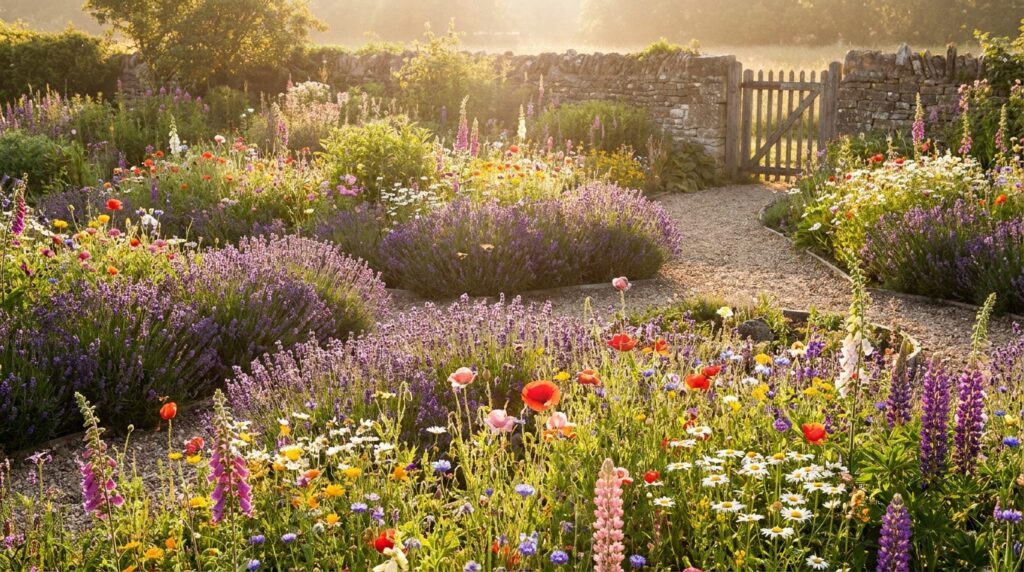
Native flowers support local food webs and are adapted to the conditions of their home region, but “native” is not a guarantee that every plant suits every bee. Solitary bees, bumblebees, and honeybees differ in size, tongue length, nesting habits, and the time of year they are active. A resilient planting offers a varied menu: shallow, easy-to-reach flowers; deeper tubular blooms; clusters of small florets; and pollen-rich flowers with exposed centers. Avoid designing around a single favorite species or a single flower shape.
Solitary bees include many small native species that forage close to their nests. Some are active for only a short part of spring or summer, so a flower that opens during their flight period matters greatly. Small, open blossoms such as spring beauty, wild geranium, and golden alexanders can be accessible to smaller bees. Larger, open flowers and clustered blooms offer other options. Provide nesting habitat as well as food: many solitary bees nest in bare, well-drained soil, while a smaller number use hollow or pithy stems. Keep a sunny, undisturbed patch of soil free of thick mulch, and avoid digging or tilling it regularly.
Bumblebees are strong-bodied foragers that can work many tubular flowers. Wild bergamot, native penstemons, and some locally native sages can offer useful summer forage, while early-flowering shrubs help queens when they first emerge. Bumblebees nest in small colonies, often in sheltered cavities at ground level. Leave some undisturbed cover near the garden rather than clearing every leaf pile and tussock. Honeybees are managed social bees that can forage over long distances and readily use masses of accessible flowers. They benefit from the same succession of nectar and pollen, but their presence should not be treated as a substitute for habitat that supports wild bee diversity.
Plant in repeated groups instead of scattering single specimens across a lawn. A drift of five to seven perennials is easier for a bee to find than one isolated bloom, and grouping can make maintenance and observation simpler. In a small bed, repeat the same species in two or three pockets rather than creating one large monoculture. Mix flower forms within each flowering period: for example, pair a flat-topped golden alexanders with a tubular penstemon, then follow them with bergamot and coneflower. Choose single-flowered forms where available and avoid pesticides, including products labeled organic, while plants are in bloom.
Regional sourcing makes a real difference. Ask a nursery where its seed was collected, whether plants were grown without systemic insecticides, and whether the species is native to your county or ecological region. A plant marketed as a “wildflower” may be non-native or invasive locally. If you are comparing options, the practical guidance in our article on choosing flowering plants for a garden can help you assess site needs alongside bloom appeal. The best bee friendly garden plants are not simply attractive on a label: they fit local conditions, flower when bees need them, and remain manageable in your specific garden.
Arrange Native Flower Borders for Easy Foraging
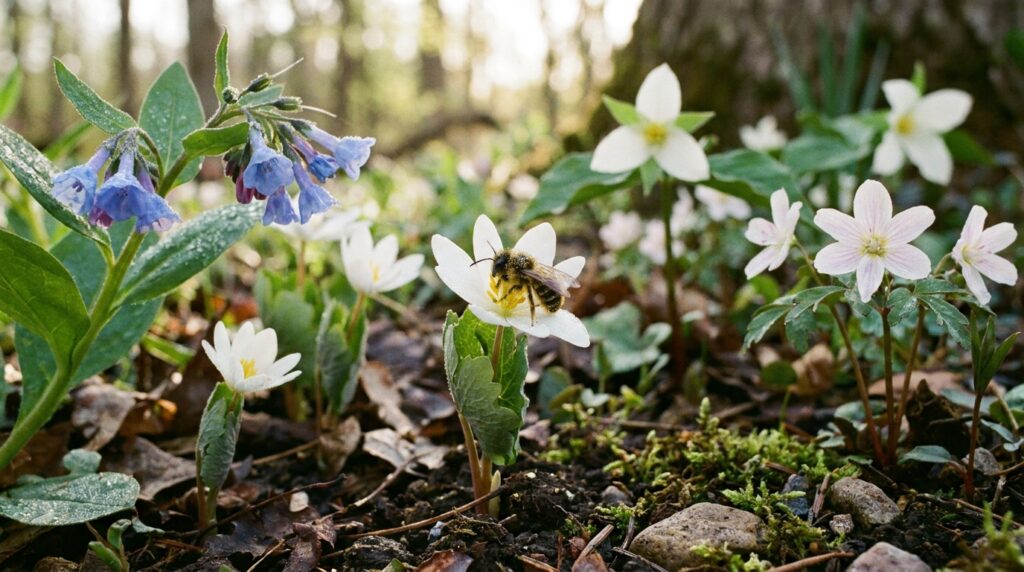
Good pollinator garden design makes flowers easy to find, reach, and revisit. Begin with sun and soil: most nectar-rich border plants flower best with at least six hours of direct sunlight, though woodland-edge natives may prefer part shade. Observe the site before planting. Note where water sits after rain, where soil dries quickly, and which areas get afternoon heat. Match plants to those conditions instead of trying to force a moisture-loving species into dry gravel. A plant that struggles may produce fewer flowers and demand extra watering, even if it is native nearby.
Arrange plants in broad drifts with a clear route through the bed. Put taller species toward the back of a border viewed from one side, or toward the center of an island bed viewed from all directions. Check mature height and width on a regional plant label, then allow room for air circulation. As a starting point, many medium perennials can be spaced about 18 to 24 inches apart; smaller species may need 10 to 15 inches, while large mountain mints or goldenrods may need 24 to 36 inches. Use the mature spread of the particular species, not these general ranges, as the final guide.
Repeat each species in clumps of three, five, or more where space allows. Repetition creates visible patches of one flower type without sacrificing variety across the whole garden. For instance, a sunny border could place spring-flowering golden alexanders near a path, use wild bergamot and coneflower in the middle, and reserve the back for taller asters and goldenrod. Plant low-growing flowers near the edge so they are not shaded by taller neighbors. Give bees a sunny landing area and avoid filling every gap with dense foliage or decorative stone.
Include water and shelter thoughtfully. Bees need water, but a deep, open bowl can be a hazard. Set out a shallow dish with pebbles or sloped stones that rise above the waterline, refresh it often, and keep it away from places where it will become stagnant. Leave some stems standing through winter and let a small area of leaf litter remain where it will not smother crowns. Keep a patch of bare soil in a sunny, low-traffic location for ground-nesting bees; do not cover it with landscape fabric, thick mulch, or gravel.
Layering can increase the usefulness of a small garden. A native flowering shrub, such as a regionally suitable willow or serviceberry, can create early-season forage above a lower layer of spring flowers. Perennials can then fill the middle and foreground. In narrow spaces, choose upright species and repeat them in a loose line, rather than squeezing in plants that will crowd one another. If your yard is compact, our guide to small garden design ideas offers ways to balance planting space with paths and seating. Well-planned native flower borders should be accessible for care, diverse in bloom time, and left with a few untidy habitat pockets.
- Sketch the bed and mark its sunniest, driest, and dampest areas.
- Place shrubs and tall perennials according to mature size and viewing direction.
- Group repeated flower drifts, then add smaller plants at the front and edges.
- Keep a modest bare-soil nesting spot and a shallow, safe water source nearby.
Plant, Maintain, and Protect the Garden Through the Year
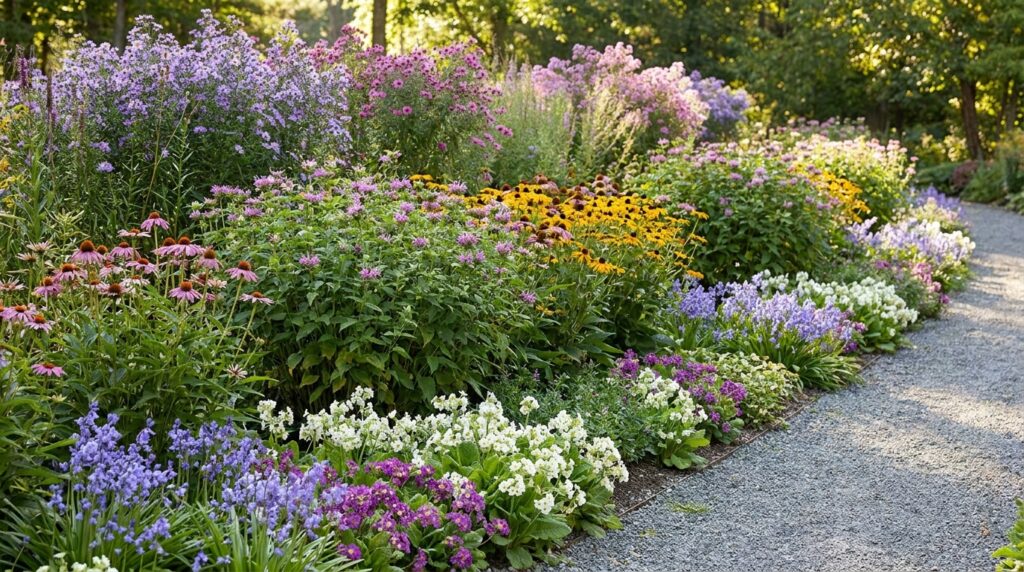
Planting time depends on climate and species, but early autumn and spring are often suitable for perennials when soil is workable and temperatures are moderate. In cold regions, plant early enough in autumn for roots to establish before the ground freezes. In hot or dry regions, spring planting can reduce heat stress, provided you can water while plants settle in. Plant shrubs according to their local nursery guidance. Before buying, check mature dimensions and the plant’s soil and moisture needs; a bargain tray of unsuitable plants often becomes a costly replacement project in time and effort.
Prepare the bed by removing persistent weeds and loosening compacted soil only as much as necessary. Avoid routine deep tilling, which can disturb soil life and ground-nesting bees. Add compost when soil needs organic matter, rather than applying a heavy dose automatically. For practical guidance on making and using compost, see the according to RHS Composting Guide. If you are working to improve soil with less disturbance, our overview of the no-dig gardening method provides additional ideas. Water new plants deeply at the root zone, then adjust frequency to rainfall and soil rather than watering lightly every day.
Mulch can conserve moisture and suppress weeds, but keep it away from the bare ground reserved for nesting bees. A thin layer of leaf mulch around established plants is usually more compatible with habitat than a thick blanket over the whole bed. Do not pile mulch against stems or shrub trunks. During the first growing season, remove weeds before they set seed and water during prolonged dry spells. Once plants are established, many regional natives need less supplemental water, though this varies by species and local weather.
Deadheading can extend flowering for some perennials, but it can also remove developing seed heads that feed birds and provide winter interest. Use a selective approach: trim a few spent flower stems if you want to encourage fresh blooms, and leave others to set seed. Do not shear every plant at once. In autumn, leave hollow or pithy stems standing through winter because some native bees use them for nesting. Cut them back in spring after consistently mild weather returns, and leave the cut stems somewhere undisturbed for a while rather than sending them straight to the bin.
Avoid spraying flowering plants and nearby weeds with insecticides. Treating blooms can expose visiting bees, and drift can affect flowers beyond the target plant. If a pest problem requires action, identify the pest first, consider physical or cultural controls, and follow local extension advice. Also avoid herbicides that remove all volunteer flowers from lawns and edges; a small patch of suitable clover or other locally appropriate flowers can supplement a border. Watch for signs of stress, such as wilt, leaf discoloration, or poor flowering, then adjust water, light, or spacing instead of immediately applying fertilizer. Excess nitrogen can produce leafy growth at the expense of flowers.
Keep a simple seasonal record: note flowering dates, bee activity, and gaps in the display. If nothing is flowering in early April, add a suitable early species next planting season. If summer growth becomes congested, divide or relocate plants during a locally appropriate cool period. A garden improves through observation, not constant tidying. These management choices help bee friendly garden plants keep flowering while preserving stems, soil, and shelter that bees need beyond the visible bloom.
Build a Reliable Bloom Calendar from Spring to Late Autumn
A written bloom calendar turns a plant list into a functioning food supply. Start with your local frost dates and observed flowering times; nursery descriptions are useful, but your garden’s microclimate may shift them by weeks. Create columns for early spring, late spring, early summer, midsummer, late summer, and autumn. List each plant under the period when it usually flowers in your area, then look for blank stretches. Aim for at least two or three flowering species in each period, with overlap between them. Different weather years can alter bloom timing, so redundancy matters.
For an eastern or central North American example, an early spring layer might include native willow and spring beauty, followed by redbud, serviceberry, or golden alexanders. Late spring can bring wild geranium and penstemon into bloom. In summer, schedule wild bergamot, coneflower, and other locally native species selected for your soil and sun. Late summer and autumn can be carried by asters and goldenrods, with additional regional natives filling the transition. In the West, choose locally adapted alternatives such as suitable native manzanitas or ceanothus for early forage where appropriate, and regional asters or other late bloomers. Do not plant a species solely because it appears in a general list; confirm that it belongs in your ecological region and will not spread invasively.
Consider flower abundance as well as calendar dates. A single small plant may open at the right time but offer little forage; a drift of several plants is more visible and productive. At the same time, avoid allowing one aggressive species to occupy the entire bed. Mountain mint and some goldenrods can spread vigorously in favorable conditions, so give them space, select clumping species where suitable, or use a root barrier only when it will not interfere with neighboring plants. Deadheading or dividing may help manage size, but check whether the plant provides seed or winter habitat before cutting it back.
Use this simple method to revise the plan each year:
- Record the first and last flowering dates for each main plant group.
- Note which bees visit, without assuming that every bee can be identified at a glance.
- Mark any two-week or longer period with few open flowers.
- Add one or two locally native species that fill the gap and suit the site conditions.
- Review the plan in autumn, then order or divide plants for the next suitable planting window.
This observation-based approach is more reliable than buying a large mixed packet and scattering it everywhere. Many seed mixes contain species unsuited to the site, and seedlings may not flower in their first year. Buy from reputable native-plant nurseries, check species names, and follow any regional guidance on seed origin. For more inspiration on a long-lasting color scheme, see our guide to purple flowers that bloom all summer, then balance any summer color with spring and autumn forage. Effective pollinator garden design is a seasonal sequence, not a single peak display. Once the calendar is in place, each new planting can solve a real gap rather than merely add another flower to an already crowded month.
With thoughtful selection and a little record-keeping, bee friendly garden plants can support foraging across the whole growing season. The result need not be a formal or perfectly tidy bed: varied flowers, safe nesting places, and a few undisturbed corners are often more valuable than a flawless lawn edge.
The Royal Botanic Gardens, Kew publishes further plant care guidance worth reading alongside this guide.
Frequently Asked Questions
Which flowers attract bees first in spring?
Choose early-flowering species native to your region. In parts of eastern North America, pussy willow, spring beauty, and redbud can provide early forage. Flowering times vary with climate, so check local records and plant labels. A flowering shrub or small tree can supply many blossoms at once, making it a useful complement to low-growing flowers.
Do solitary bees need more than flowers?
Yes. Many solitary bees nest in bare, well-drained soil, while some use hollow or pithy stems. Leave a sunny patch of soil uncovered and avoid routinely disturbing it. Keep some stems standing over winter, and avoid pesticides that could harm bees or contaminate flowers.
Can I support bees in a small garden?
Yes. Repeat compact groups of suitable flowers in containers or a narrow bed, and choose plants with different bloom times. Prioritize a few well-matched species over a crowded assortment. A shallow dish with stones can offer a safe drinking place, while an undisturbed patch of soil or stems provides nesting habitat.
Are native plants always the best choice for bees?
Locally native plants are a strong foundation because they fit regional ecosystems, but suitability still depends on the site and the bee species. Choose flowers with accessible pollen and nectar, include several shapes and bloom periods, and avoid invasive plants or cultivars with inaccessible double flowers. When in doubt, ask a regional native-plant organization or extension service.
Should I cut back bee-friendly plants in autumn?
Usually, it is better to leave at least some stems and seed heads standing through winter. Hollow stems can shelter nesting bees, and seeds can feed wildlife. Cut back selectively in spring after cold weather eases, and keep the stems in a quiet place for a while so any occupants are not discarded immediately.
How many bee-friendly plants should I put in one border?
There is no single number. Base the plan on mature plant size, available sunlight, and the length of the border. Group several plants of each species where space allows, repeat groups, and include at least a few choices for each part of the season. Leave room for mature growth and nesting habitat rather than filling every inch.
Conclusion: Make Every Part of the Season Count
A thriving bee garden combines local native flowers, overlapping bloom periods, accessible planting groups, and habitat that remains useful when flowers fade. Start with your site conditions, fill the earliest and latest gaps first, and add species gradually as you observe which bees and plants succeed. Choose bee friendly garden plants suited to your region, avoid pesticides, and leave a few quiet nesting places. Ready to plan your next garden project? Explore more practical ideas at Blossom Gardens Hub and create a border that welcomes pollinators from spring to autumn.
