
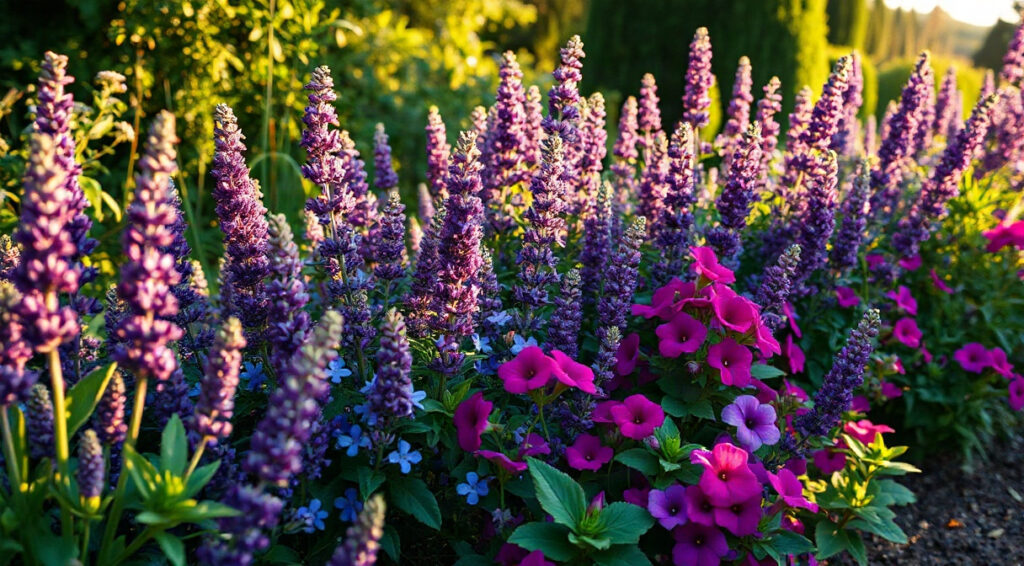
Purple flowers that bloom all summer can bring months of colour to a border, patio pot or pollinator-friendly garden, but no single plant flowers continuously in every climate or growing condition. The most reliable display combines repeat-flowering perennials with annuals that replace spent blooms with fresh buds. Choose varieties suited to your sunlight, soil and local season, then water and prune at the right time. This guide explains which plants to grow, how to extend their flowering, and what UK and US gardeners should adjust for their weather.
What Makes Purple Flowers Last Through Summer?
“All summer” usually means a long succession of flowers from late spring through late summer, rather than one plant producing an unbroken carpet of blooms. A perennial may flower for several weeks, pause briefly, then repeat after trimming; an annual can keep setting buds until frost if it has enough water, nutrients and regular deadheading. Combining plants with different peak periods creates a more continuous display and reduces the pressure to find one supposedly tireless variety.
Start by noting how many hours of direct sun your planting area receives in June. Most long-flowering purple choices, including lavender, salvia, verbena and petunia, perform best with at least six hours of sun. In light shade, consider bigleaf or mountain hydrangea varieties with purple-toned flowers, or use containers that can be moved to a brighter spot. Deep shade is a common reason sun-loving plants produce leaves but few flowers: extra fertiliser will not make up for a lack of light.
Match the plant to the conditions
Check drainage before choosing a plant. Lavender and many salvias struggle in heavy, persistently wet soil, particularly through a cold UK winter. Improve a small area with grit or compost as appropriate, or grow them in a raised bed. In contrast, hydrangeas prefer more consistent moisture and benefit from shelter from the harshest afternoon sun. A plant described as drought tolerant still needs regular watering while establishing; its mature resilience is not a reason to let a new planting dry out.
Soil pH can influence the colour of some bigleaf hydrangeas, but it does not turn every purple flower blue or violet. The effect depends on the variety, soil chemistry and availability of aluminium. Treat the plant label as the best guide to the likely colour range, and do not repeatedly add amendments without testing the soil. Other purple-flowered plants, such as catmint and verbena, are much less dependent on soil pH for their flower colour.
- For sun and lean soil: consider lavender, catmint, hardy geraniums and compact salvias.
- For rich, moist soil: look at garden phlox, hydrangeas and selected hardy geraniums.
- For containers: combine a compact perennial with a trailing annual such as purple calibrachoa.
Think in layers as well as months. A low edging plant can flower early, a mid-border salvia can provide upright spires, and an annual can fill gaps while slower perennials establish. Check mature width before planting: squeezing plants together to make an instant full border often reduces airflow and increases mildew. For more garden planning ideas and inspiration for purple flower gardens, browse Blossom Gardens Hub and adapt the combinations to your own site.
Finally, distinguish repeat bloom from a long single flush. A plant that blooms for four weeks in June may be beautiful but cannot carry late summer on its own. Look for variety descriptions such as repeat flowering, reblooming or long season, and combine early, middle and late performers. This is the foundation for selecting the longest blooming perennials for borders rather than relying on a single plant to do everything.
Seven Perennials for a Purple Border With Staying Power
Perennials return year after year, but their flowering windows differ. The following choices offer a useful mix of height, habit and repeat performance. Confirm hardiness for your location before buying: a plant that survives reliably in a mild UK garden may need protection in a colder US zone, and a heat-loving cultivar may struggle in a cool, damp site. Give each plant the spacing listed on its label; the measurements below are practical starting points, not substitutes for cultivar-specific instructions.
Reliable choices from edging to the back of a border
- Catmint (Nepeta ‘Walker’s Low’): Its soft blue-violet flower spikes usually arrive in early summer. After the first flush, shear the plant back by roughly one-third to encourage fresh foliage and another flowering period. Allow about 45–60 cm (18–24 inches) between plants. It tolerates dry spells once established but can flop in rich, overfed soil.
- Salvia nemorosa ‘Caradonna’: Deep purple-blue spikes and dark stems provide a strong vertical accent. Cut off faded flower stems in midsummer; new spikes may follow when growing conditions are favourable. Space around 40–50 cm (16–20 inches) apart. Avoid waterlogged winter soil, which can cause crown loss.
- Hardy geranium ‘Rozanne’: This spreading perennial bears violet-blue flowers over a long period, often from early summer into autumn in suitable conditions. Give it room to weave through the front or middle of a border, usually around 60–90 cm (24–36 inches) wide. Trim tired foliage if it becomes untidy, rather than expecting it to remain compact without space.
- Verbena bonariensis: Tall, airy stems carry small purple flower clusters above lower plants and attract pollinators. It flowers for a long summer period in sunny, free-draining sites, but may be short-lived in cold or wet areas. Leave some seed heads if you welcome self-seeding, or remove them to keep seedlings in check.
- Garden phlox ‘Laura’: Purple flowers with contrasting eyes appear in summer, and the plant suits a fertile border with steady moisture. Space plants about 45–60 cm (18–24 inches) apart and water at the base. Good airflow helps reduce powdery mildew, a frequent problem when phlox is crowded or its leaves stay damp.
- Lavender ‘Hidcote’: Its dark purple flower spikes are especially useful in sunny, well-drained borders and low hedges. It is not a continuous-bloom plant, but a midsummer trim after flowering helps keep its shape and can extend the garden’s overall purple season. Never cut deeply into old, leafless wood, which may not regrow.
- Bigleaf hydrangea ‘Endless Summer’: This reblooming type can produce flowers on old and new growth, depending on climate and care. Provide moist, well-drained soil and morning sun or light shade in hot regions. Its colour can vary with soil conditions, and a late hard prune may remove developing flower buds.
For a cohesive border, repeat two or three varieties rather than planting one of everything. A group of three salvias can create a stronger visual rhythm than a single specimen, while catmint can soften the edge around them. Place taller verbena behind lower plants and leave enough space for mature spread. In a small garden, choose compact cultivars and use a pot for a plant that would otherwise overwhelm the border.
Deadheading is not equally useful for every perennial. Removing spent salvia spikes or trimming catmint after its first flush can prompt another display, while cutting back lavender at the wrong time can damage its woody framework. Read the pruning advice for the named cultivar and observe how it responds in your garden. A repeat-blooming hydrangea may not need flower removal to make more blooms, and removing its old flower heads in late autumn can expose developing buds to winter damage.
Perennials are often the backbone of the longest blooming perennials for borders, but annuals fill gaps and keep containers colourful while young perennials mature. Use both categories for a display that has structure as well as a long flowering season.
Annuals and Deadheading Techniques for More Flowers
Annuals complete their life cycle in one growing season, so many keep producing flowers when regularly prevented from setting seed. This makes them valuable for hanging baskets, window boxes and spaces between young perennials. Purple petunias, calibrachoa, verbena, annual salvia and lobelia all offer useful choices, but their needs are not identical. Petunias and calibrachoa enjoy sun and regular feeding; lobelia generally appreciates cooler conditions and can flag in intense heat.
How to deadhead without damaging new buds
Deadheading means removing faded flowers, usually before seed develops. On a petunia, pinch or snip the spent flower and its small stalk just above a healthy leaf or new side shoot. For a plant with many small blooms, such as verbena, trim the faded flower cluster back to a leafy junction. Use clean, sharp scissors for larger plants, and avoid cutting through a cluster of unopened buds. The purpose is to redirect growth, not to shorten the plant indiscriminately.
- Inspect once or twice a week: In warm, productive weather, fading flowers can turn to seed quickly. A regular short check is easier than a major cleanup.
- Remove the whole spent flower: Leaving the swollen seed capsule on a plant can encourage it to spend energy maturing seed rather than forming more buds.
- Trim selectively: Cut back only faded stems or clusters unless the plant has become leggy. For a tired petunia, a light trim of some stems can encourage branching while other stems continue flowering.
- Water and feed afterward as needed: Deadheading cannot compensate for dry compost or exhausted nutrients. Follow the container-fertiliser label and water when the surface begins to dry.
Some modern annuals are self-cleaning, meaning old flowers drop without routine removal. Trailing calibrachoa and some petunia series may need less deadheading than older varieties, although occasional grooming keeps plants tidy. Check the variety label rather than assuming every plant with a purple flower benefits from the same pruning. Avoid pulling at a flower so roughly that you break a tender stem or remove the next set of buds.
Container care is especially important in summer. A hanging basket can dry faster than a border, particularly in a sunny, breezy position. Check moisture daily during hot spells and water thoroughly until excess drains from the base; do not leave the pot standing in water. Use a container with drainage holes and refresh or replace compacted compost when replanting. Feed flowering annuals according to the product directions, since overfeeding can create lush foliage at the expense of flowers.
Deadheading is not necessary for every annual or every gardener. Leave selected blooms if you want seed for next year, food for birds or a more informal self-seeding effect. Avoid deadheading plants grown specifically for their seed heads. Where plants are labelled self-cleaning, focus instead on water, feeding and removing damaged growth. These small choices make deadheading annuals for more flowers a targeted technique rather than a repetitive chore.
Do not wait until every bloom has faded before pruning an annual that has become lanky. In midsummer, cut back a portion of its longest stems by about one-third, keeping plenty of healthy growth and buds. The plant may take a short time to recover, so do this before a holiday or heatwave rather than when you need immediate display. If roots are congested, watering runs straight through or flowering has stalled despite care, moving the plant to a larger pot may help more than repeated trimming.
Planting and Seasonal Timing in UK and US Gardens
Timing depends on frost risk, local climate and whether you are planting seeds, young plants or established perennials. In much of the UK, tender annuals are planted outside after the last frost risk has passed, often from late May into June, although sheltered southern gardens may be ready earlier and colder northern or upland areas later. In the US, use your local frost dates and USDA hardiness zone as planning tools, not guarantees; coastal, mountain and urban gardens can differ substantially from the nearest broad regional average.
Plan from frost dates, not a fixed calendar
Prepare perennial beds when the soil is workable and not saturated. Planting in spring gives roots time to establish before summer heat; early autumn can also work in many mild regions if plants have time to settle before the ground freezes. Water new plantings slowly and deeply, then check soil moisture rather than watering automatically every day. A layer of mulch helps even out moisture, but keep it a few centimetres away from plant crowns and woody lavender stems to reduce the risk of rot.
For annuals, harden off greenhouse-raised plants over about a week. Set them outdoors in a sheltered position for a few hours at first, then gradually lengthen their exposure. Planting tender petunias straight into cold, windy conditions can stall growth or damage leaves, even if the calendar suggests it is time. Space plants according to their expected spread: crowded containers dry unevenly and have poor airflow, while overly wide gaps in a border may take weeks to fill.
Adapt choices to regional weather
- Cool, wet UK gardens: Prioritise drainage for lavender and salvias. If winter soil stays wet, use a raised bed or a container with ample drainage rather than adding a thick, moisture-trapping mulch around their crowns.
- Hot US summers: Give plants a thorough morning watering and consider afternoon shade for hydrangeas and lobelia. Mulch borders after soil warms, and check baskets more than once a day during extreme heat if they dry rapidly.
- Dry-summer regions: Group drought-tolerant perennials together so irrigation can be adjusted to their needs. Do not place moisture-loving phlox beside lavender and water the whole border as if both want the same conditions.
- Cold winters: Check hardiness ratings and protect vulnerable container roots, which are more exposed to freezing than roots in the ground. Some plants sold as perennials in warmer areas are best treated as annuals in colder locations.
Consider how a plant’s season shifts with temperature. Heat can shorten a flowering flush, while a cool summer may delay it. In a hot spell, a short break in blooms is not always a sign of failure: keep the root zone evenly moist, remove spent flowers and wait for cooler weather before applying strong feed or severe pruning. In the UK, prolonged rain can be more damaging to a sun-loving purple plant than a brief dry spell; in much of the US, summer heat and rapid container drying are common concerns.
For general plant-care context, the Royal Horticultural Society’s according to Royal Horticultural Society houseplant guidance is intended for indoor plants, so use outdoor plant labels and local growing advice when deciding how to care for a garden border. That distinction matters: a watering schedule designed for a houseplant is unlikely to suit a sun-exposed basket or a newly planted perennial.
Before buying, check the plant label for mature height, width, flowering months, light and hardiness. Buying a plant in bloom can help you confirm its colour, but a few open flowers do not reveal its eventual size. Keep labels until you know how each variety performs. A simple garden notebook recording planting date, first flower, pruning and any mildew or drought issues makes it easier to choose dependable performers next season.
Summer Care, Troubleshooting and Border Design
Once plants are established, a little observation can prevent most setbacks. Check soil beneath the surface before watering: the top may look dry while the root zone remains damp, particularly in heavy soil. Water at the base in the morning when possible, which gives leaves time to dry and reduces conditions favourable to fungal problems. In containers, water until it runs from the drainage holes, then empty saucers so roots are not left sitting in water.
Diagnose fewer flowers before adding fertiliser
If a plant has plenty of leaves but few blooms, first check light and recent pruning. A salvia planted in shade may stretch and flower poorly, while a hydrangea pruned in late winter may have lost buds on old wood. Next consider feeding: a high-nitrogen fertiliser can encourage foliage rather than flowers. Use a balanced or flowering-plant feed only when appropriate, and follow the label; applying extra concentrate does not speed up flowering and can damage roots.
Yellowing leaves can signal several different problems. On a plant in wet soil, they may point to poor drainage or stressed roots; on a container plant during a heatwave, they may reflect drought. Check moisture and drainage before changing feed or treating for disease. Powdery mildew on phlox is more likely when plants are crowded, air circulation is poor or leaves experience stress. Remove badly affected material, improve spacing when practical and water soil rather than repeatedly wetting foliage.
Flowers that fade quickly during a heatwave may be responding to heat stress rather than a lack of deadheading. Water deeply, apply mulch around border plants without covering crowns, and give vulnerable containers temporary afternoon shade. If you are away, ask someone to check baskets and newly planted beds; a single dry spell can undo weeks of establishment. Conversely, do not keep watering a plant whose soil is already saturated. Persistent wetness is a frequent cause of root and crown problems in lavender and salvias.
Build a border that stays interesting
Combine flower form, height and foliage so the display remains attractive between flushes. Pair the upright spikes of ‘Caradonna’ salvia with the billowing habit of catmint, then add a low-growing annual at the edge. Silver or grey-green foliage can make rich purple blooms stand out, while white or pale pink flowers soften the contrast. Repeat a colour or plant in several places to create continuity; avoid scattering single specimens so widely that each looks disconnected.
Leave room for mature plants. A border that looks sparse in its first year can become overcrowded after perennials reach full size. Temporary annuals can fill gaps while permanent plants grow, but place them where you can reach them for deadheading and watering. Remove annuals when frost ends their season and add compost before replanting. In a mixed border, avoid digging deeply around established crowns, because roots may spread farther than the visible foliage suggests.
Deadhead based on the plant’s growth habit. Snip individual petunia flowers, remove faded salvia spikes, and shear catmint after a flush if it is still healthy and has time to regrow. Do not apply the same hard cut to lavender, hydrangea and every annual: pruning at the wrong stage can remove buds, expose old wood or weaken a stressed plant. If a plant is struggling, identify whether the cause is light, moisture, drainage, crowding or cold before pruning it back.
At season’s end, decide what to tidy and what to leave. Remove diseased leaves and exhausted annuals, but consider leaving sound seed heads for wildlife or natural reseeding. Some perennials benefit from being cut back in spring rather than autumn, especially where foliage or stems offer winter shelter. Keep a short list of which plants flowered longest and which needed too much attention. That record helps you refine a practical garden of purple flowers that bloom all summer rather than simply buying more plants.
Frequently Asked Questions
Which purple flowers bloom longest in a sunny border?
Hardy geranium ‘Rozanne’, catmint ‘Walker’s Low’, and verbena bonariensis can provide a long season in sunny conditions, although flowering duration varies with climate and care. Combine them with repeat-flowering salvia and annuals such as petunias to bridge gaps. Match each plant to your soil and local hardiness conditions for the most reliable results.
Do purple perennials really flower all summer without a break?
Usually not. Many perennials flower in a long flush or produce repeat blooms after spent stems are removed, but heat, drought and local growing conditions affect the timing. Plant varieties with overlapping flowering periods and use annuals to maintain colour between perennial flushes.
How often should I deadhead annual flowers?
Check flowering annuals once or twice a week during active growth, and more often if warm weather quickly dries flowers and develops seed capsules. Remove faded blooms before seed forms, taking care not to cut off nearby buds. Self-cleaning varieties may need only occasional grooming.
Can I grow purple summer flowers in partial shade?
Yes, but choose plants suited to lower light. Some hydrangeas tolerate partial shade, especially morning sun with protection from harsh afternoon heat. Most salvias, lavender and petunias flower best with substantial direct sunlight, so they may bloom less in a shady site.
Why are my purple flowers producing leaves but few blooms?
Insufficient light, excess nitrogen, overcrowding, unsuitable pruning or water stress can all reduce flowering. Check sunlight first, then review feeding and pruning for the named variety. If the soil is either waterlogged or very dry, correct that problem before applying more fertiliser.
Should I cut back lavender after it flowers?
Yes, a light trim after flowering can keep lavender compact, but do not cut into old, leafless wood. Remove the faded flower stems and a small amount of leafy growth, leaving plenty of green shoots. In cold, wet regions, good drainage is just as important as careful pruning.
Keep Your Summer Border in Colour
A dependable purple display comes from matching plants to their growing conditions, combining perennials with annuals, and responding to each plant’s pruning needs. Start with a few proven varieties, leave room for mature growth and use regular deadheading where it encourages fresh buds. For more inspiration and practical garden ideas, visit Blossom Gardens Hub, then plan a border that suits your garden and enjoy colour through the summer season.
