
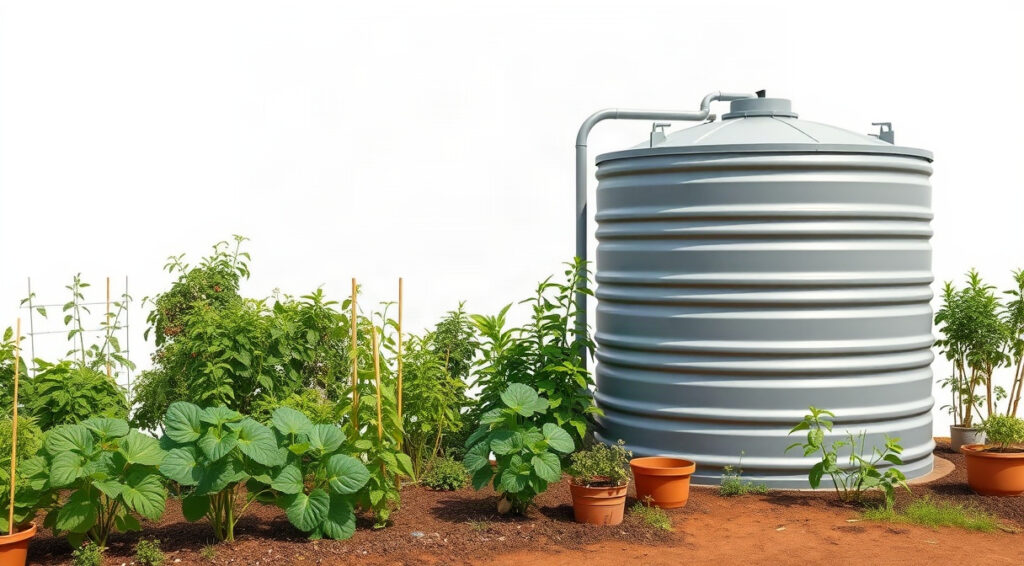
rainwater harvesting for garden planning helps you turn roof runoff into a practical reserve for dry spells, while carefully managed household greywater can stretch that supply. The safest approach starts with separating rainwater from wastewater, checking local rules, and choosing delivery methods that keep water off edible leaves and fruit. A productive water-wise garden is not just a tank: it combines clean collection, sensible storage, soil care, and crops suited to your climate.
This guide explains how to calculate likely rainwater yield, set up a basic greywater irrigation system, and select drought tolerant vegetables that can keep producing when conditions are dry. Use the recommendations as a planning framework, then confirm local health and plumbing requirements before connecting any household drain to the garden.
Plan Rainwater Harvesting for Garden Needs
Begin by estimating how much water the garden uses and how much your roof can realistically supply. A simple collection estimate is roof area in square metres × rainfall in millimetres × 0.8. The 0.8 factor allows for losses from splashing, wet surfaces, and first-flush diversion. For example, a 50-square-metre roof receiving 20 millimetres of rain could yield about 800 litres. This is an estimate, not a guarantee: roof shape, wind, gutter condition, and local rainfall patterns all affect the result.
Compare that yield with the beds you intend to irrigate. One square metre of garden receiving 10 millimetres of water needs about 10 litres, before accounting for evaporation or runoff. A weekly 20-millimetre application to a 10-square-metre bed therefore represents roughly 200 litres. Check local weather records and keep a simple garden log; a dry-season average is more useful for tank planning than annual rainfall alone.
- Measure the roof area that drains into the intended downpipe, rather than the entire house footprint.
- Note the longest expected dry spell and the crops that must stay productive during it.
- Prioritize young transplants, fruiting plants, and containers; established, mulched beds usually need less frequent watering.
- Leave a safe overflow route that carries excess water away from foundations and neighboring property.
Choose a tank size that fits your space, likely rainfall, and demand. Bigger is not automatically better: an oversized tank may rarely fill in a dry climate, while a small barrel can overflow after a single storm. Several linked, covered containers can be easier to position than one large tank, but the base must be level and strong enough to support the full water weight. A litre of water weighs about a kilogram, so a full tank is a substantial load.
Look at the roof material and its condition before collecting water. Avoid runoff from surfaces treated with lead-containing coatings, copper-based chemicals, or other products that could leach contaminants. Do not collect from roofs with frequent heavy bird fouling or from areas exposed to industrial dust without checking local advice. Keep rainwater for irrigation rather than drinking or food preparation unless it has been treated and tested for that purpose.
Good rainwater harvesting for garden planning also includes a backup for unusually long dry spells. Mulch, shade cloth, improved soil structure, and a smaller planted area can all lower demand. For ideas on arranging beds and paths so water-saving features work together, see these garden focal point and space-planning ideas. A tank is most useful when the garden layout makes every litre easy to deliver where roots can reach it.
Collect and Store Rainwater Safely
A reliable rainwater harvesting for garden setup guides water from roof to downpipe, through debris screening and first-flush diversion, and into a covered tank. Fit sturdy gutter guards to keep out leaves, then clean gutters regularly, especially in autumn and after storms. A mesh screen at the tank inlet blocks larger debris, but it does not make the water sterile. Inspect every connection for leaks and make sure the tank lid closes securely.
A first-flush diverter sends the initial roof runoff away from the tank. This early flow can carry dust, pollen, bird droppings, and other material accumulated during dry weather. The diverter should be easy to empty and clean; a forgotten, clogged device may stop collection or allow dirty water to bypass it. Follow the product instructions to size it for your roof and local conditions. Keep the overflow screened and direct it away from the house, foundations, and paths where standing water could create a hazard.
Use an opaque, tightly covered tank designed for water storage. Light encourages algae, and an open container invites mosquitoes, wildlife, and falling debris. Install a fine screen over vents and overflow openings, and check it for tears. Keep the tank stable on a firm base, protect pipes from damage, and prevent children from accessing openings. Do not use a container that previously held fuel, pesticides, or other hazardous substances, even if it appears clean.
- Clear the roof and gutters before the rainy season and after major leaf fall.
- Check the diverter, inlet screen, cover, outlet valve, and overflow before the first substantial rain.
- Label non-potable water clearly and keep taps or hoses separate from drinking-water connections.
- Inspect stored water for unusual odor, visible contamination, or a damaged cover; clean and repair the system as needed.
Stored rainwater can be used through a watering can, a gravity-fed hose, or a low-pressure drip line, depending on the tank outlet and garden slope. A filter suitable for the irrigation equipment helps reduce clogging, but it is not a treatment for drinking. Flush lines periodically and protect emitters from sediment. Deliver water slowly at soil level, ideally in the morning, so it can soak into the root zone rather than run across a dry or compacted surface.
For larger systems, a covered cistern and pump may be appropriate, but observe local building, plumbing, and electrical rules. Never connect a rain tank directly to household drinking-water plumbing without an approved backflow-prevention arrangement installed according to code. For general garden soil care and safe use of organic material, consult the according to RHS Composting Guide. Finished compost and mulch can help soil hold moisture, but keep them clear of plant crowns and avoid burying stems.
When using rainwater harvesting for garden storage through a dry season, do not wait until the tank is nearly empty to change your routine. Check the level weekly, repair leaks promptly, and reserve some water for newly planted crops. If the supply is dwindling, water deeply and less often, weed regularly, and harvest mature produce instead of sustaining plants that have finished cropping.
Reuse Household Greywater With Guardrails
Household wastewater is not all the same. Greywater usually means relatively lightly contaminated water from showers, baths, and bathroom sinks; some locations also permit laundry water. Toilet wastewater is blackwater and must never be diverted to an edible garden through a home-built system. Kitchen sink and dishwasher water can contain grease, food waste, and stronger cleaning residues, so many guidance programs exclude it. Definitions and legal requirements differ, so check your local authority before collecting or redirecting any household water.
A simple greywater irrigation system may divert suitable shower or bath water through an approved pipe to mulch basins around appropriate plants. Keep the route short, use gravity where permitted, and make sure the design cannot backflow into potable plumbing. Do not store untreated greywater for later use: it can develop odors and microbial growth. Use it promptly, usually within 24 hours, or follow local rules if they set a shorter limit. A closed, direct-to-landscape setup is preferable to buckets left standing or spray irrigation.
Choose low-sodium, low-boron soaps and detergents that are compatible with plants and soil. “Natural” on a label does not automatically mean garden-safe. Avoid products containing boron, bleach, disinfectants, high levels of sodium, or harsh drain cleaners. Laundry softener can add salts that harm soil structure and sensitive crops. If you use medicated products or strong cleaning chemicals, do not direct that water to edible beds. Rotating between suitable water sources can also limit repeated buildup of salts in one spot.
- Apply greywater beneath mulch or directly to soil, never through a sprinkler or onto leaves and fruit.
- Keep it away from root crops, leafy vegetables eaten raw, and any part of a plant likely to be harvested directly from the wetted area.
- Do not use it on seedlings, in pots with poor drainage, or on waterlogged ground.
- Use a separate, clearly marked pipe or container and prevent children and pets from drinking it.
- Stop during heavy rain, when soils are saturated, or if the system smells, pools, or causes plant stress.
Use greywater preferentially on ornamental plants, trees, and established fruiting plants where local guidance allows. For edible crops, keep the water below the soil surface, apply it to the root zone, and avoid contact with the edible portion. Specific health rules vary, and some jurisdictions prohibit greywater on food crops entirely. The U.S. Environmental Protection Agency offers background on water reuse, but local codes determine what is allowed at your address: read its basic information about water reuse and verify the rules with your local health or water authority.
A well-designed greywater irrigation system is not a substitute for safe sanitation or sound plumbing. Do not use water from a diaper rinse, toilet, or medical waste source. Check mulch basins for pooling and move outlets if water repeatedly accumulates in one place. If your soil develops a crust, plants show leaf-edge burn, or water begins to smell, stop the flow and investigate detergent residues, drainage, and local soil conditions before restarting.
Choose Crops That Suit Recovered Water
Crop choice depends on both drought tolerance and water quality. Rainwater collected from a clean roof is generally the more flexible irrigation source for vegetables, although good hygiene still matters. Greywater calls for more caution: local regulations may restrict food-crop use, and the safest edible-garden approach is to keep it below mulch and away from harvestable surfaces. No vegetable is immune to unsuitable soaps, salts, or contaminated water. Match the crop to the source and use potable water when safety is uncertain.
Many drought tolerant vegetables produce reliably with less frequent watering once established, especially in warm climates. Consider ‘Red Salad Bowl’ leaf lettuce only in cool seasons, since lettuce bolts quickly in heat; it is not a good choice for greywater exposure. For hot, dry periods, try okra such as ‘Clemson Spineless’, Swiss chard such as ‘Fordhook Giant’, and heat-adapted cowpeas such as ‘California Blackeye No. 5’. These crops still need water to establish and set a good crop. Drought tolerance means resilience, not zero irrigation.
Tomatoes can cope with a measured, consistent watering routine better than repeated cycles of wilting and flooding. ‘Roma’ is a practical paste tomato, while compact ‘Patio Choice Yellow’ suits a large container where rainwater can be targeted accurately. Peppers, including ‘California Wonder’, are also useful in warm beds, but they need steady moisture during flowering and fruit development. Mulch and deep watering help both crops; irregular drought followed by heavy watering can contribute to fruit cracking or blossom-end rot.
Squash and beans offer further options. ‘Butternut’ winter squash spreads, so allow roughly 90–120 centimetres between plants or train vines where space permits. Bush beans such as ‘Provider’ can be spaced about 8–10 centimetres apart in rows roughly 45 centimetres apart, subject to the seed packet and local climate. These crops need water at germination and while flowering or fruiting, but a thick organic mulch can reduce surface evaporation once seedlings are established.
- Prioritize okra, cowpeas, chard, and established peppers for warmer dry spells.
- Use lettuce, spinach, and other quick leafy crops in cooler months when water demand and heat stress are lower.
- Grow root crops such as carrots and radishes with clean rainwater or another approved source, not greywater unless local rules explicitly allow it.
- Group plants with similar water needs so a single irrigation zone does not overwater one crop and starve another.
Planting time is a water-saving tool. In many regions, sow heat-sensitive greens in late summer or early autumn for a cooler growing window. Start warm-season crops after frost danger has passed and soil has warmed; in mild climates, a second crop may be possible. Follow regional planting calendars, since the right month varies greatly. Give transplants a deep initial soak with clean water, then maintain moisture while roots establish before reducing frequency.
When using a greywater irrigation system around food plants, favour established fruiting crops only where regulations permit and deliver water beneath a deep mulch layer. Avoid applying it to edible leaves, berries, or fruit that rests on the soil. For additional ideas on preparing healthy garden soil, see these cardboard composting tips for garden beds. Compost can improve water retention over time, but do not assume it makes unsuitable water safe.
Operate the System Through a Dry Spell
Build a routine that starts with the soil, not the calendar. Push a finger or a small trowel several centimetres into the bed; if the root zone is still moist, wait before watering. Light daily sprinkling wets the surface but can encourage shallow roots and lose water to evaporation. Instead, apply water slowly enough to soak into the root zone. Sandy soils may need smaller, more frequent applications; clay soils absorb slowly and can become waterlogged if a large volume is applied at once.
Drip lines or soaker hoses are efficient because they place water near roots and keep foliage drier. Use a filter if the system requires it, and check emitters by observing flow at the start and end of each line. A blocked emitter can leave one plant stressed while its neighbour looks fine. If using a watering can, aim at the base of each plant and avoid splashing soil onto leaves. Water early in the day when practical, particularly during hot weather.
Mulch is one of the simplest ways to make stored water last longer. Apply a 5–8-centimetre layer of clean straw, shredded leaves, or another suitable organic mulch after the soil has warmed and seedlings are established. Leave a small gap around stems to discourage rot and pests. In cool, wet spring weather, wait to mulch heat-loving crops until the soil warms. A cover that is too thick or packed against stems can shelter slugs and keep soil excessively damp.
- Inspect tank level, gutters, screens, valves, and irrigation lines once a week.
- Check soil moisture at root depth in several parts of each bed, not just at the surface.
- Water newly planted crops first, then fruiting plants; reduce supply to mature crops nearing harvest.
- Record rainfall, tank level, irrigation, and crop response so you can adjust the next season.
Keep rainwater and greywater lines clearly separated. A safe arrangement should prevent accidental cross-connections and avoid any route that could push non-potable water back into a drinking-water supply. Use required backflow devices and labels, and have plumbing work inspected where local rules require it. A gravity-fed diversion may seem simple, but household drainage modifications can create health risks if vents, traps, or overflow routes are altered incorrectly. Use a qualified professional when a project goes beyond a permitted, simple landscape diversion.
Watch for signs that water quality or delivery needs attention. A crust on the soil, yellowing leaf margins, persistent odor, standing water, or sudden plant decline are reasons to pause greywater use. Flush irrigation lines with clean water where appropriate, improve drainage, and review detergent ingredients. Do not add more water to a bed that is already saturated. If the tank is almost empty, direct remaining clean water to crops at a critical growth stage and let less productive plants finish naturally.
Weather extremes can make a routine ineffective. During a heat wave, temporary shade cloth over tender greens can reduce stress; remove or adjust it when conditions cool. Wind increases water loss, so a porous windbreak may help exposed beds. For practical layout inspiration that combines paths and structures, explore these patio pergola design ideas, while ensuring any shade does not block crop light or roof access for tank maintenance.
Good rainwater harvesting for garden practice means treating every source as part of a managed system. Clean collection surfaces, covered storage, suitable crops, soil-level delivery, and careful observation work together. If local regulations do not allow greywater on edible crops, use it only for permitted landscape plants and reserve collected rainwater or an approved supply for vegetables.
Frequently Asked Questions
Can I water vegetables with harvested rainwater?
Usually, yes, if the roof and collection equipment are suitable and the stored water is protected from contamination. Screen the inlet, divert the first roof runoff, and keep the tank covered. For crops eaten raw, avoid splashing soil or water onto edible parts, and wash produce with clean drinking water before eating.
Is greywater safe for vegetables?
Rules vary, and some places prohibit it on food crops. Where permitted, use suitable household sources, apply water below mulch at soil level, and keep it off edible leaves and fruit. Never use toilet wastewater, and avoid water containing bleach, disinfectants, or unsuitable detergents. Check local public-health guidance before use.
How long can untreated greywater be stored?
Do not store untreated greywater for later irrigation. Use it promptly, generally within 24 hours, and follow any stricter local limit. Standing wastewater can develop odors and microbial growth. A direct, approved diversion to the landscape is safer than leaving buckets or tanks of greywater sitting around.
Which vegetables cope best with dry weather?
After establishment, okra, cowpeas, chard, and some peppers can handle warm, dry conditions better than many tender greens. Choose varieties suited to your region and provide water during germination, flowering, and fruit development. These drought tolerant vegetables still produce better with mulch and consistent root-zone moisture.
How do I keep mosquitoes out of a rainwater tank?
Use a tightly fitting opaque lid and fine mesh on vents and overflow openings. Check screens for gaps or damage, and remove standing water around the tank. Do not leave open barrels or buckets uncovered. Follow local mosquito-control guidance for rainwater storage.
Can rainwater and greywater share the same irrigation pipe?
Do not combine them casually. Keep non-potable water clearly identified and prevent cross-connections with potable plumbing. Any permitted shared arrangement must meet local plumbing and backflow rules. Separate lines and valves make it easier to control water quality and avoid sending unsuitable water to sensitive crops.
Conclusion: Make Every Stored Litre Count
Reliable dry-spell gardening starts with a realistic supply plan: collect clean roof runoff, protect it in covered storage, and use any permitted household greywater promptly and carefully. Choose crops suited to your climate, keep water at soil level, and improve moisture retention with mulch and healthy soil. Check local rules before using wastewater around food crops; when in doubt, reserve it for approved landscape plants.
Start with one gutter-fed tank, a well-mulched bed, and a weekly inspection routine, then improve the system as you learn how much your garden uses. For more practical growing and design guidance, visit Blossom Gardens Hub garden guides and plan a productive garden that makes better use of every safe water source.
